Where the Mind Wanders
(while watching the WNBA)
 INDVS
INDVS MIN
MIN LASVS
LASVS PDX
PDX CONVS
CONVS DAL
DAL TORVS
TORVS GSV
GSV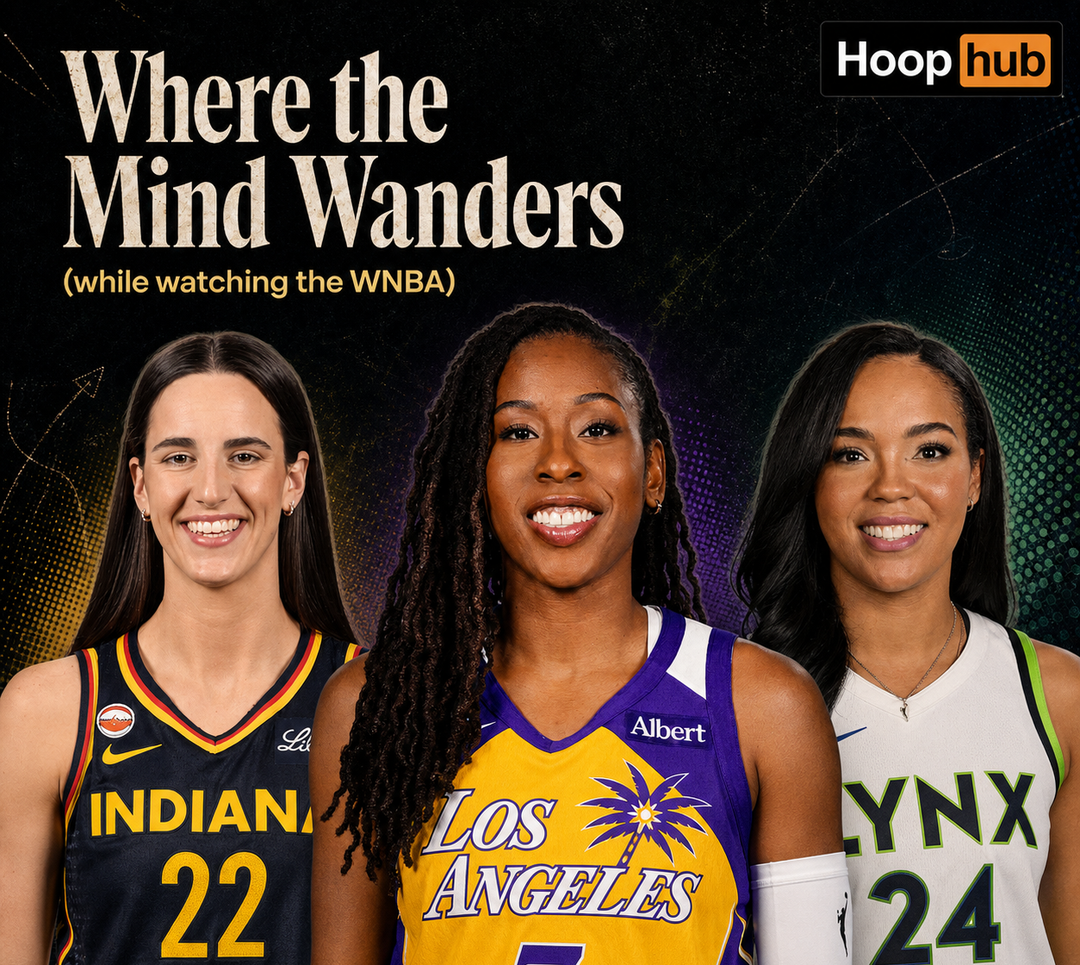
01 A Good Day for the Product
I want to open this article with a surprisingly high amount of praise for the WNBA. You did very well today, which is Sunday.
I first got into betting on the WNBA because I was losing too much money betting on baseball. I am also an avid basketball fan, so it only felt right to give the league a try. Then I realized that, despite the memes and the general discourse around the WNBA, the level of play is surprisingly high. There is real star power, and there is real talent that jumps off the screen.
Since then, I have devoted a lot of time to watching the games, and I have been betting on them professionally. I say all of that because there are certain days, and certain times of the year, when the WNBA needs to put its best foot forward if it wants to succeed as a product. That starts with the days it has primarily to itself during the summer. On those days, the league needs to assemble the best possible slate for television.
WNBA purists, if those are actually a thing, might want different matchups. But the teams the league sent out today put on a show. Kudos to whoever made the slate.
02What a Good Coach Actually Looks Like
The next thing I want to talk about is who the best coaches in the WNBA are and what exactly constitutes a good coach. I would argue that it goes much further than team success. At the end of the day, winning is the ultimate indication of decent coaching, but there are subtleties and characteristics of well-coached teams that I saw throughout the morning and want to bring some attention to.
The first thing is that Stephanie White is a legitimate coach. Maybe she already gets enough credit. I am not really sure, because who actually reads WNBA media? What I do know is that she gets her players up for everything. Their intensity and effort levels are always high. It feels like if somebody is not trying, I will not see her in the next Fever game.
Her players are constantly in the right spots and performing the right roles. You do not see Lexie Hull taking a bunch of pull-up threes. It is easy to dismiss White's impact by saying she has high-level talent and intelligent players, and that may be true. But there is a real togetherness to the way those women play. In my opinion, it makes them better than the sum of their parts.
Also, shout-out to Michaela Timpson. I am certain she is going to be dunking in a few years. She is genuinely athletic, and whenever I think of her, I go back to an insane chase-down block she had a few weeks ago in one of the most crucial moments of a game. It swung everything. I also remember it because it was the reason I won my bet, but the larger point is that she has real star potential. Not just quality-player potential. Star potential. She also has an amazing coach, so I am buying Michaela Timpson stock today.
Despite the Fever losing, they played a great game against the number one team in the league, the Minnesota Lynx. It is also simply nice to watch Napheesa Collier play basketball. She is another reason I fell in love with the WNBA.
This comparison could be completely off the mark because they are fundamentally different players, but Collier represents the level I think Sonia Citron can reach. I am talking about an ultra-athletic, well-conditioned, fundamentally sound and intelligent player. Napheesa went crazy today. It was a great game, and I am glad it came first because it was a great show.
I cannot overstate how happy I am when the WNBA gets something right. I want this league to succeed, potentially more than some of the people working for it.
03Ariel Atkins and Basketball Balance
The next game of the day was Sparks versus Fire. It came right on the heels of the Kelsey Plum trade, which I did not really mind. More than anything, it affirmed that the Sparks' offseason decisions disrupted a core that could have flourished. Still, they moved off the situation quickly, so they deserve some credit. Now they can figure out what they actually have.
They pulled out a road win against a very well-coached, hard-playing Fire team. Maybe the Sparks had a little extra juice because of the trade, but they earned the win. The Fire gave them everything they had and made some incredible shots. The Sparks are a team I have criticized for looking passive and only half invested in games, but this time they executed when it mattered most.
I want to give a special shout-out to Ariel Atkins, a player I have had my grievances with. During her time with the Chicago Sky, and even early in her time with the Sparks, it felt as if she had an unrealistic expectation of what she could do. It reminds me a little of the Russell Westbrook conversation. That does not mean those players are not talented. Atkins absolutely is. If you watched the final defensive possession, or really her entire game, you saw an elite two-way guard.
What she is not is Luka Dončić, an offensive savant who can pull up for one-legged step-backs and play with an almost innate command of every possession. At times, Atkins seemed to be trying to portray herself as that kind of player. She is at her best when she doubles down on being a secondary ball handler or a second option.
That language can sound diminishing, as if I am downplaying her skill, but I am not. I am huge on basketball balance. For a team to achieve it, everybody has to understand that roles are shaped by personnel. Those roles will not look exactly the same on every team, but players with similar skill sets often need to provide similar things from one stop to the next.
Atkins needed to find where her strengths would be most valuable. That means being fiercely competitive on defense and taking a small step back on offense. This may sound blunt, but it is meant as a productive observation rather than a slight: with players like her, less can be more. She has a real offensive bag, but it is not endlessly varied. At times, it felt as if she were going head-to-head with Kelsey Plum for usage and trying to establish who was the best guard.
I like where Atkins settled in during this game. She looked comfortable in a role where she could still be the best player, or at least a co-star, without forcing herself to own every possession. I loved watching her play.
These are two middle-of-the-pack teams, and this was a meaningful game for seeding. I was happy to see two middling teams bring that much energy. It reflects well on where the WNBA is right now, and I cannot say that enough.
04A Challenge to WNBA Coaches
The official rant from the unofficial spokesman of the WNBA is about coaches. Specifically, let us think about how we use challenges.
Maybe there should be an introductory course coaches have to pass before they are allowed to run a WNBA team. I am not calling out anyone in particular, and this criticism could apply across every level of basketball. But at the highest level, we should be able to do a little mental math and critical thinking.
Challenging an out-of-bounds call in the first quarter, for example, is usually not a good idea. I know Alex Sarama is a big believer in challenging only when points are involved. When I first heard that, my reaction was simple: okay, so they know that is an option, right?
I see coaches challenge calls to appease a player or show that they have her back. In theory, I understand it. In practice, are we trying to win games or make players feel better? If a coach needs a bad challenge to prove loyalty and win over the locker room, that team may need a different coach. A coach's loyalty should be established through everything that happens off the court, not through one strategically weak decision during a game.
I do not think ordinary reaching fouls are worth a challenge. My biggest pet peeve, though, is when a coach refuses to challenge a call that would fairly obviously be overturned. Maybe it would not immediately put points on the board, but it could remove an undeserved foul from one of the team's best players. That player's usefulness makes the challenge valuable. Too often, the coach saves it and later spends it on a call with much less value.
The next time you watch one of these games, pay attention to when the coaches challenge. Does the decision make sense? Is it in line with the math?
It is almost like following a blackjack chart. Nobody is saying the book will work every single time. Sometimes you have to follow your gut, and plenty of times the cards will go against you. Officiating also includes human error, luck and favoritism. But there still has to be a playbook. This type of foul, on this player, at this point in the game should either be worth a challenge or not.
Coaches do not need to become robots. They just need to stop treating every challenge as if the situation exists outside probability, personnel and game context.