Introduction
Ranking things matters. Ranking them accurately matters even more. Too much WNBA analysis, especially from the league’s slop-media wing, uses counting stats as a substitute for context. One player has a great coach; another carries an impossible workload. One operates inside a superteam that manufactures clean looks; another is asked to solve broken spacing possession after possession. Those differences matter.
Open almost any Instagram debate and you will find alleged WNBA historians reciting shooting percentages, assist totals and turnover counts as if averages are the definitive measure of a player’s ranking or career. They are not. A box score cannot tell you whose team depends on her most or how much a player elevates the people around her. Defensive metrics such as steal totals do not explain how well someone rotates within a system or consistently produces solid contests. Averages do not reward the player who makes the correct basketball decision possession after possession. They rarely capture gravity, role difficulty or the cost of surviving a bad system.
This problem exists in every sport, and it is why I avoid arguing in comment sections. Society has not yet advanced enough to handle sports nuance. Until it does, I can only make my own rankings and let everyone else argue about them.
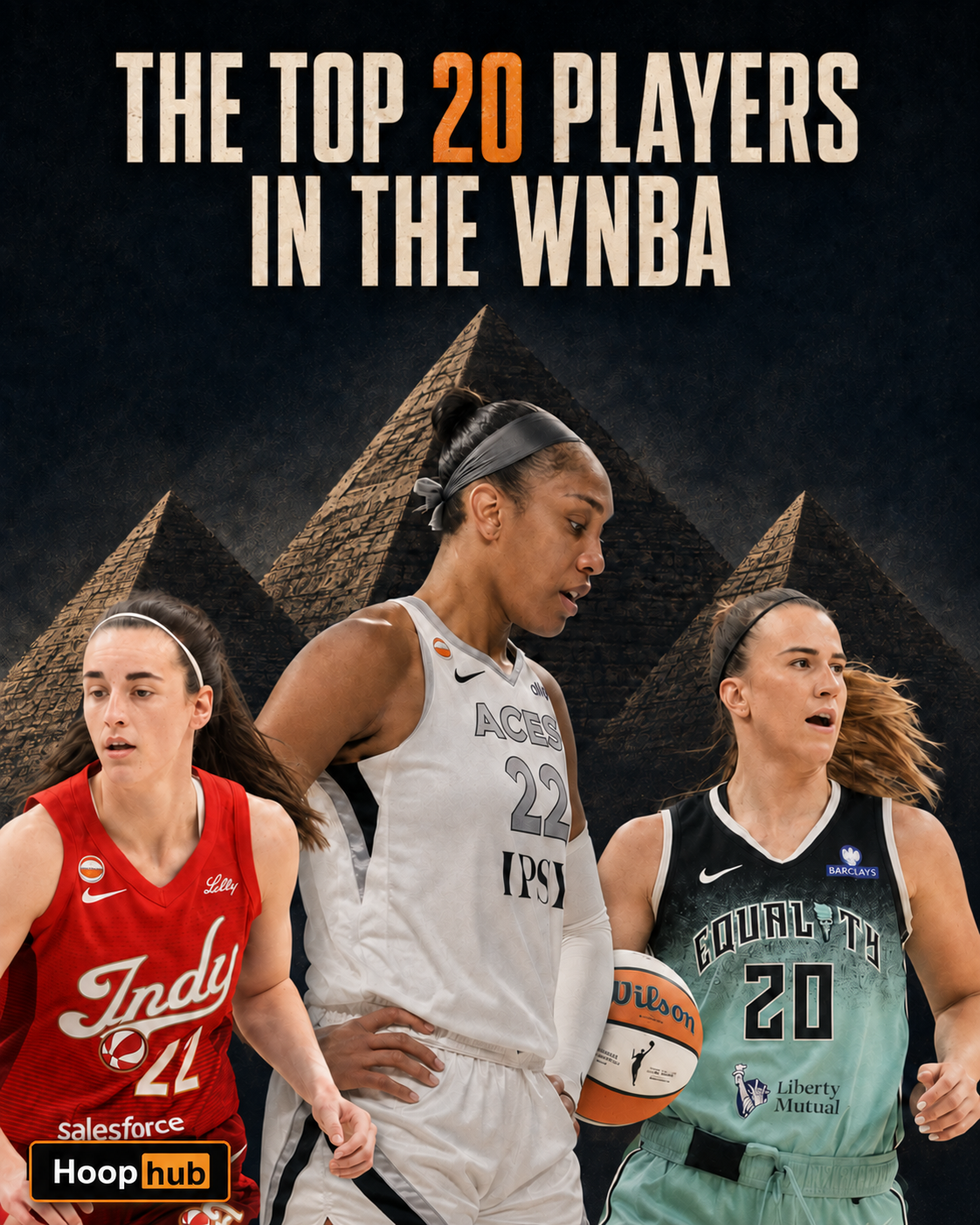
This list weighs pedigree, consistency, workload, context and contribution to winning. I am not writing a full scouting report for every player because nobody needs 500 words explaining why A’ja Wilson is the best player in the world. I am focusing on the placements most likely to draw scrutiny, then closing with honorable mentions and a few categories for the players coming next. So, without further ado, the top tier of the WNBA is as follows.
The Bus Drivers 🚌
The Batmans · Ranks 1–6
If you have one of these six players, you are not merely making the playoffs. You have a legitimate path to a championship. These are the league’s true floor-raisers: players who are the system, control the game from one or both ends of the floor, and improve everyone around them in distinct ways.
 A’ja Wilson
Duh.
 Napheesa Collier
Where someone ranks Napheesa Collier usually tells me two things: how long they have followed the WNBA and whether they actually watch the games. For the past few seasons, Collier has given A’ja Wilson a real run for the title of best player in the world. There is nothing gimmicky about her game. She is relentlessly conditioned, fundamentally sound and seemingly always around the ball, making the extra play before anyone else recognizes it is available.
Her injury last season was brutal because she had been the unquestioned centerpiece of the Minnesota Lynx. If this ranking were based only on the current season, she would not be this high. But at full strength, Collier can be every bit as dominant as A’ja. Olivia Miles has taken much of the spotlight this year while Collier has worked her way back into game shape, but I would not expect that arrangement to last forever.
The simplest description of Collier is that she is a superstar with elite basketball IQ who is always willing to do the high-effort, dirty work. She runs, defends, communicates and cleans up possessions with the urgency of a role player, then gives you the offensive production of a franchise cornerstone. She is great with her back to the basket and reads the entire defense, ready to drive hard or swing the ball depending on the coverage. Some players enter possessions with predetermined decisions, essentially turning their offense into a gamble. Phee has ascended beyond that, which makes her the second-best player in the league, in my opinion. That combination is rare in any era.
 Caitlin Clark
Caitlin Clark is one of the most polarizing players in sports, which makes ranking her feel more complicated than evaluating her. Strip away the circus and watch what happens on the floor: she is the third-best player in the WNBA. The results support it, but the box score still cannot fully explain how she controls a game without shooting. She is also one of the biggest victims of box-score arguments. People are quick to point out her turnovers or bad nights from three, completely ignoring her gravity and consistently good decision-making relative to her usage.
I was too young to watch Steve Nash in real time, but Clark reminds me of what I have seen from Tyrese Haliburton and an older LeBron James. Her playmaking bends the floor until passes no other team can complete start to look routine.
What secured this spot is that Clark’s scoring has become easier and more dependable. Her developing midrange game complements elite finishing and limitless range. She is a basketball savant. Please put that on the record. I will say it again in the hope that people’s bias will be disarmed momentarily: Caitlin Clark is a basketball savant in the same way Luka Dončić is. Her vision exists in a different stratosphere from the rest of the league, and it is difficult to argue that anyone below her affects an entire offense more profoundly.
Olivia Miles
The secret is out on Olivia Miles, but I am only now accepting that she is already better than Paige Bueckers and everyone else below her on this list. I normally weigh pedigree and year-over-year consistency heavily, so her smaller sample makes this sound dangerously hyperbolic. Then I watch her against elite teams, players and coaches, and she is consistently the best player on the court, not by a little. She controls pace and has a finishing package the WNBA has truly never seen. What the box score cannot capture is how easily she touches the paint, possession after possession, compromising defenses and breaking them down. She is No. 1 on my list at putting teams in the blender and creating the easiest, most efficient shots basketball can offer.
Miles has shades of Kyrie Irving, with more playmaking and a sharper command of the pick-and-roll. I hesitated to place her over Paige, but Miles keeps looking across the court and taking established stars’ lunch money. She has every ingredient required to become box-office television and, God willing, one of the best players this league has ever seen.
Whenever one of my friends tries to get into the WNBA, which is rare, not going to lie, I tell them to watch Olivia Miles and the Minnesota Lynx. Miles simply moves differently from every other player in the league. She dribbles differently, plays at a different pace, reads the floor differently, and carries a passion that jumps off the screen. I do not know how else to articulate it: if you really want to see what this league has to offer, watch No. 5 on the Minnesota Lynx. She has the potential to affect the WNBA the way Stephen Curry affected the NBA, even though their styles are completely different. Her arrival could be monumental for the growth of the league, and I cannot wait to watch it happen.
 Paige Bueckers
 Rhyne Howard
This entire list began with another Instagram page ranking Allisha Gray ninth and leaving Rhyne Howard outside its top 10. That was my sign that somebody who watches basketball needed to enter the conversation. Omitting Howard while elevating her teammate is not just a difference of opinion. It misunderstands who drives the Atlanta Dream and is RFK Jr.-level dangerous misinformation.
I have compared Howard to Jayson Tatum: a big initiating wing who takes a heavy volume of threes and can defend at a high level. That is essentially what she is. On her best night, she can look like the best player in the league. Calling her that over a full season would be a stretch, but she should live comfortably in the back half of the top 10 for years. When the jumper catches fire, she becomes the most overwhelming player on the floor. She is the bus driver in Atlanta. Do not let a careless ranking tell you otherwise.
The Robins
Ranks 7–14
This tier reflects how deep the league has become. These players are not quite the same championship-driving engines as the top six, whether because of shot-creation limits, inconsistency or a smaller effect on teammates. Give one the keys and she may drag you to the playoffs. Pair two or three of them, and your team becomes terrifying. As a second-best player, each is championship material.
 Jonquel Jones
Jonquel Jones plays on a stacked roster with championship chemistry and years of continuity. The Liberty have terrorized the league together, but this has been an uneven, injury-plagued season, one that has also revealed unexpected depth. What follows may be premature, so proceed carefully.
I had long viewed Sabrina Ionescu as the head of the snake and the best player on the team. Before her injury, she was the WNBA’s closest Stephen Curry analogue because there was much more to her game than shooting. Her return to form has been slower than I expected, though she could come out of the break, make everything and shut me up. Until then, Jones has been the Liberty player who has impressed me most.
I did not watch the season in which Jones won MVP, so I cannot pretend to speak to that peak. This year, however, she has looked like Karl-Anthony Towns: a center whose willingness to fire from three warps the defense. Her shooting gravity can rival that of an elite guard, and her passing amplifies it. She occasionally attempts a pass so ambitious that the receiver realizes what is happening only after the window has closed. But when the chemistry is there, her two-player game with Marine Johannès, for example, the result can look like basketball porn 👉👌. More than in any other year, I appreciate Jones’s dependability and leadership.
Kelsey Mitchell
I may have to defend this one. I am not sure where the broader Kelsey Mitchell power ranking currently sits, but eighth is high praise. I have seen people call her better than Clark, which is inaccurate, but she has been better this season than every player listed below her.
At times she resembles the Kyrie Irving archetype represented above: one difficult make after another until you start wondering, and I know this is sexist, if you have ever seen a woman be this talented and unguardable. Speaking as someone who has bet against the Fever, there is a special frustration in watching Mitchell manufacture points from baseline out-of-bounds plays with the shot clock dying. Every defense knows she is the target, and Indiana still gets her the ball. You would hope teams have the common sense to think, ‘She does this on literally every f***ing inbounds play. She is probably getting the ball here. Let’s guard her.’ In reality, Mitchell and the Fever have mastered that part of basketball. It is a subtle superpower and differentiator.
She is going to be terrifying in the playoffs because there is a good chance she will take a lot of the shots at the end of games. This year more than ever, she has seemed ready for the moment. Other teams, beware.
Sabrina Ionescu
The placements of Sabrina Ionescu and Breanna Stewart are partly acts of respect because their current seasons alone do not justify spots this high. I love the Liberty, and their championship over Minnesota is what pulled me into the league. I will never forget watching at the Plaza Sportsbook in Las Vegas when Sabrina hit one of the toughest shots I have ever seen to send the game to overtime. The entire room paused for half a second, processed what had happened, then exploded. I will love these players forever for that moment.
That affection does not erase the current form. Stewart has stayed healthy, but after several seasons in which I thought she was underrated, she has come back to earth. Her efficiency has dipped, and her offense has leaned more heavily on drawing free throws while the midrange jumper has gone missing. That has pushed her toward more difficult finishes and reduced the defensive gravity she once carried on every possession.
I hope both players return from the break looking like their earlier selves. I also have a Liberty future riding on it, and the return of Sabally deserves an article of its own. Either way, I am rooting for Stewie and Sab. Sabrina, in particular, has a few quiet ‘washed’ allegations to beat before they become loud ones.
Breanna Stewart
 Kahleah Copper
If I had to describe Kahleah Copper in four words: all gas, no brakes. She has always found another gear in international basketball, and we should learn more over the next two weeks. She saved Team USA repeatedly last year, producing outrageous stretches and making critical shots despite sharing the floor with an absurd amount of talent.
Copper reached the Finals last season and, even if she was not the best player on her team, she was often the most dependable source of a difficult bucket. She is the heart, and maybe some of the soul, of the group. She attacks north to south, uses her strength to create finishing angles and can punish defenses from all three levels. Once the first few threes and midrange jumpers fall, she becomes terrifying.
Against Washington, I watched her put together a Russell Westbrook-style opening burst, scoring roughly 20 of her team’s first 24 points through move-out-of-my-way drives and passing-lane gambles. It was chaotic, forceful and special. Alyssa Thomas has slowed somewhat, and the team around them has looked old, which has made Copper’s leadership even clearer. She is driving the bus now more than ever.
 Gabby Williams
This ranking might require some defense. Everyone is aware of Gabby Williams, and her talent is indisputable. She is a blue-chipper who has already proved a lot in this league. This year, however, she has finally been handed the keys to her own bus. With the keys in her hand, she has taken a team with a solid infrastructure and turned it into a juggernaut. It is still hard to move her into the top 10 because this is the most she has won, and her team is really f***ing good.
I was on the record saying her move to Golden State was the biggest of the offseason because the Valkyries desperately needed someone with A-plus talent, which she has. She is a top-tier defender, and her offensive game, while it leaves a little to be desired, is still very good. Defensively, she has produced some of the most impressive performances of the year, giving players like Olivia Miles and Kelsey Mitchell a genuinely hard time. She is long, strong and quick, which allows her to switch onto basically anyone who is not a center. She also has excellent anticipation, evident in how many passes she jumps and how quickly the Valkyries recover when the defense is at a disadvantage.
In a year or two, I would not be surprised if she is in the top 10 and bordering on the top five. If she stays with Golden State, her accolades will pile up. She is also the leader of a dangerous French national team that, in the coming years, I predict will be just as good as, if not better than, our own USA team. That is not because the talent will even out. It is because she is a smart, tenacious leader. Do not get it misunderstood, though: on a night when she is hot, she looks as good as any wing in the league.
Jackie Young
Do I really have to explain? Jackie Young is f***ing dangerous.
Satou Sabally 🦄
Satou has been hard for me to evaluate because she has struggled with injuries, and much of her time on the court has been spent playing herself into better shape and comfort. Based only on this season, she has not been the 14th-best player in the league. But her overall talent, she is literally nicknamed the Unicorn, combined with what we saw during her playoff run last year is enough to make me feel obligated to include her. She has generational talent, which is not something I say lightly. In a good year, she could f*** around and find herself in the MVP race and the top five of Hoop Hub’s famous player pyramid. Her production has been streaky, though, which is why I cannot automatically place her in the top 10.
She might return from this short break and look better than everyone else in this tier, which is another reason the evaluation is so difficult. For now, this feels fair, but beware: when Sabally is healthy, she is much better than the 14th-best player in the league. She is as good as someone like Rhyne or any of the Liberty stars.
When a player is nicknamed the Unicorn, it usually means she is a big or forward with guard skills, someone who can pull down a rebound and dribble through traffic all the way to the other end. She is comfortable with her back to the basket and behind the arc. Ladies and gentlemen, that is exactly what Satou Sabally is. I compare her to Luka without the playmaking. Luka can get a good shot wherever and whenever he wants, and Sabally has that same effect on the court when she is right.
The Bus Rider Express
Ranks 15–20
If one of these players is your second-best option, your ceiling is lower, but context matters. Stack a roster with two or three Tier 3 players and you can absolutely build a contender. These players may flash Tier 2 impact on a given night, yet they do not consistently possess the individual firepower to rescue a bad team or overpower a broken environment. That does not diminish their value. Each fits a coveted prototype or supplies a rare, winning skill.
 Sonia Citron
Sonia Citron is one of my favorite players in the league, so I will admit my bias. I still think her ranking as the 15th-best player is well deserved. Although the stats may not always reflect it, she is the bus driver of the Washington Mystics.
The way I describe Citron is that she plays like your friend who is a soccer player joining pickup every now and then. She is exceptionally conditioned and athletic. She plays an annoying, body-bumping style of defense, always meeting the opponent where she is and always running the floor. The soccer-player analogy feels fitting because, in my experience, those players never fall for dribble moves or fakes. They only care about staying right next to you. It is truly one of the most annoying things in pickup. Citron also rarely seems tired.
The difference between Citron and your friend is that she is incredibly skilled. She has a beautiful jump shot that goes in a lot, which is badly needed because of some of Washington’s spacing limitations, and she is great at finishing around the rim. She is elite off the ball as a cutter and floor-spacer, another display of her basketball IQ. She is not especially vocal but seems to lead by example with her effort.
Citron is everything you want in your best player, but I would love to see her get a chance as a secondary star because her skill set fits that role even better. She has been able to defer a little more as the team around her has improved. Citron is an elite, elite defender who knows how to play around other talented players, like the one who comes next. f***, I love Sonia Citron.
Shakira Austin
Alyssa Thomas
Ms. 10-point triple-doubles.
Chelsea Gray
Point God.
Allisha Gray
Sniper. Sniper. 🎯
 Nneka Ogwumike
Madam President. 🇺🇸
Honorable Mentions
Pick Your Poison
These are the players I debated most seriously for spots 15 through 20. At this point, the exercise becomes pick-your-poison. I chose to value repeatable contributions to winning and to ask what each player’s production would look like under a franchise-player workload. Some have already been handed the keys, and the results have exposed the gap between high-end talent and top-20 impact.
That does not make any of these choices indefensible. You could place several of them between 17 and 20 without starting an argument with me. My point is simply that, based on what I have watched, not merely what the averages say, the players above them have contributed more consistently to winning.
 Brittney SykesMarina MabreyJordin CanadaArike OgunbowaleKelsey Plum
 Sydney TaylorAliyah BostonKayla McBrideVeronica Burton
Will Be Here Soon
 Carla Leite
 Dominique MalongaAngel ReeseKiki IriafenJessica Shepard
A Year Away from Being a Year Away
Cameron Brink Leïla LacanRae BurrellKiki RiceFlau’jae JohnsonKamilla CardosoAzzi Fudd